EN
EN



CIJ vs. PIJ Inkjet Printers: Which Coding Technology Fits Your Production Line?
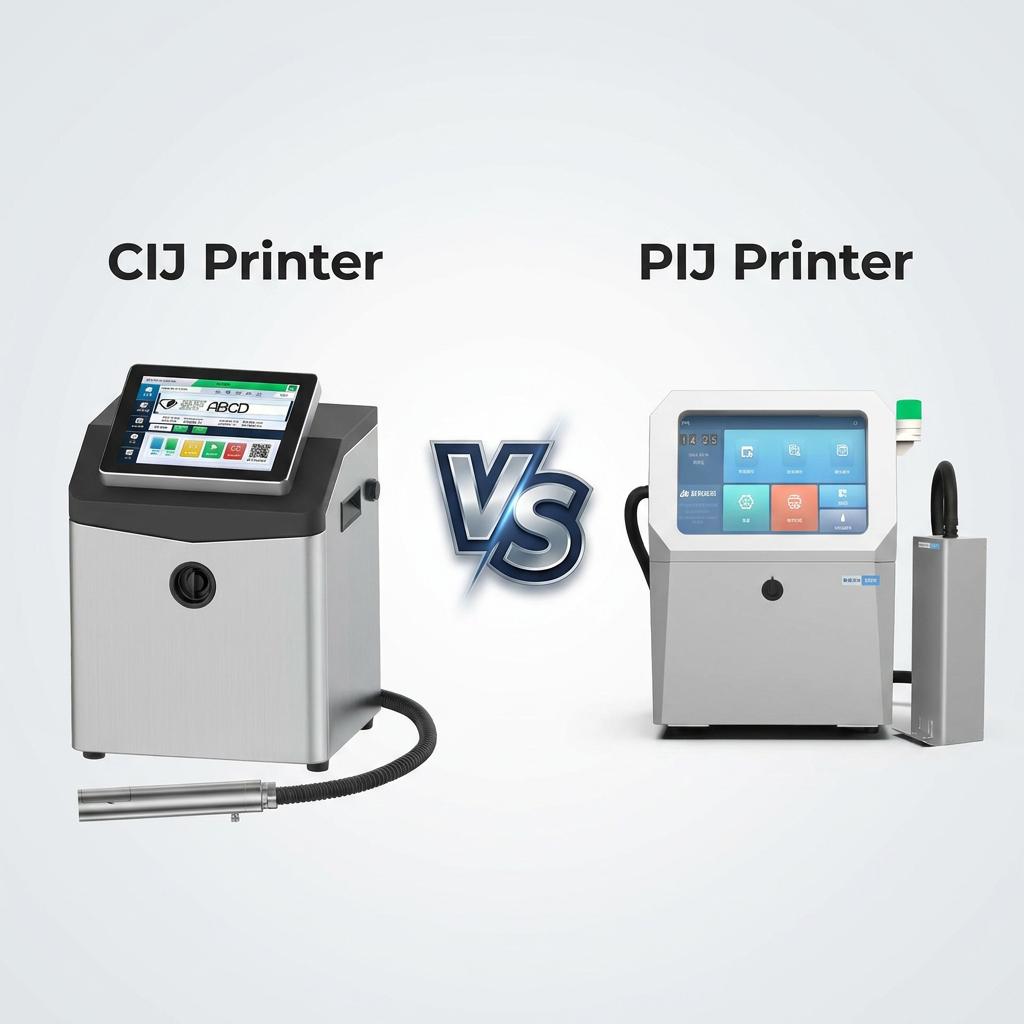
CIJ vs PIJ Technology Comparison
The Evolution of Industrial Coding
In the modern manufacturing landscape, industrial coding is a critical component of product traceability, regulatory compliance, and brand protection. Whether you are packaging pharmaceuticals, extruding PVC pipes, or bottling beverages, the demand for clear, reliable marking has never been higher. For decades, the Continuous Inkjet (CIJ) printer has dominated the factory floor. However, the rise of Piezoelectric Inkjet (PIJ) technology, particularly High-Resolution UV PIJ printers, has introduced a powerful alternative.
Factory managers are frequently faced with a challenging purchasing decision: Should they stick with the proven speed of CIJ, or upgrade to the high-resolution capabilities of PIJ? In this comprehensive technical guide, we will analyze the core mechanisms, distinct advantages, and ideal industrial applications for both CIJ and PIJ coding machines.
How Continuous Inkjet (CIJ) Technology Works
As the name suggests, a Continuous Inkjet (CIJ) printer operates by generating a non-stop stream of ink droplets. Inside the printhead, a high-frequency acoustic oscillator breaks a pressurized stream of solvent-based ink into thousands of uniform micro-droplets per second.
These droplets pass through a charging electrode. When a character needs to be printed, specific droplets are given an electrical charge. These charged droplets then fly through a high-voltage deflection field, which alters their trajectory just enough to land on the moving product, forming dot-matrix characters. The uncharged droplets fly straight into a gutter tube and are recycled back into the main ink tank for continuous use.
The Strategic Advantages of CIJ:
Ultra-High Speed Operations: CIJ printers are the undisputed champions of speed. Because the ink droplets are continuously flying at high velocity, CIJ coders can keep pace with extreme production lines, easily exceeding speeds of 300 meters per minute (perfect for canning or wire extrusion).
Long-Throw Printing: The high velocity of the ink droplets allows the CIJ printhead to sit further away from the product (often 10mm to 30mm). This non-contact capability is essential when printing on curved, irregular, or fragile surfaces like the bottom of soda cans or the curvature of a glass bottle.
Instant Drying on Non-Porous Surfaces: CIJ inks are heavily solvent-based (utilizing MEK or Acetone). Upon hitting the substrate, the solvent evaporates almost instantaneously, leaving a permanent mark even on slick plastics, metals, and glass without smudging.
How Piezoelectric Inkjet (PIJ) Technology Works
In contrast to the continuous flow of CIJ, Piezoelectric Inkjet (PIJ) utilizes "Drop-on-Demand" (DOD) technology. A PIJ printhead contains hundreds of microscopic chambers, each backed by a piezoelectric crystal.
When an electrical pulse is applied, the piezoelectric crystal physically deforms. This microscopic flexing creates a sudden pressure wave inside the chamber, forcing a single, precise droplet of ink out of the nozzle. Drops are only fired exactly when and where they are needed to form the image.
The Strategic Advantages of PIJ:
Unrivaled High Resolution (Up to 600 DPI): While CIJ is limited to readable but basic dot-matrix text, PIJ printers deliver crisp, photographic-quality prints at 600 DPI or higher. This is mandatory for printing dense 2D QR codes, Grade-A scannable barcodes, complex brand logos, and detailed variable data graphics.
Large Format and Wide Print Areas: CIJ printheads typically max out at around 15mm to 20mm in print height. PIJ printheads can be stitched together to print massive labels, high-visibility shipping graphics, and full-box coding, effectively eliminating the need for pre-printed corrugated boxes or costly sticker labels.
UV Ink Compatibility and Adhesion: Many modern PIJ printers utilize UV-curable inks. Instead of waiting for a solvent to evaporate, UV ink is instantly solidified by an attached LED UV light. This creates a highly durable, scratch-resistant, and chemical-resistant mark on challenging substrates like glossy flexible packaging, coated metal sheets, and varnished woods.
The Ultimate Comparison: Choosing the Right Printer
When deciding between CIJ and PIJ for your facility, consider the following four critical operational factors:
1. Print Quality and Content Requirements If your requirement is simple—such as a basic 2-line expiration date or a lot code—CIJ is highly effective and economical. However, if your packaging requires high-density scannable QR codes for consumer engagement, complex graphics, or anti-counterfeiting micro-text, PIJ is the only technology capable of delivering the required DPI.
2. Substrate Shape and Print Distance The physical shape of your product heavily influences the choice. If you are printing on the concave bottom of a moving aluminum can, the "throw distance" of a CIJ printer is required. Conversely, if you are printing on flat surfaces like folding cartons, steel plates, or moving webs of flexible packaging film, the PIJ printhead can be positioned close to the substrate, maximizing its high-resolution output.
3. Maintenance and Uptime CIJ printers inherently require more routine maintenance. The continuous recycling of solvent-based ink exposes the fluid to air, requiring constant additions of "makeup fluid" to maintain correct viscosity. Furthermore, the complex gutter system requires regular cleaning to prevent blockages. Equipped with Active Internal Ink Circulation Systems, these PIJ printers keep the UV ink in constant motion inside the printhead. This prevents heavy pigment sedimentation (especially with white inks) and virtually eliminates nozzle clogging, ensuring near-zero maintenance downtime.
4. Total Cost of Ownership (TCO) The initial capital investment for a CIJ printer is generally lower. However, the ongoing operational costs are higher due to the constant consumption of expensive makeup solvents and regular replacement of internal fluid filters. A PIJ printer represents a higher upfront investment but boasts a significantly lower running cost. Because PIJ is Drop-on-Demand, it only consumes ink when actively printing. There is no makeup fluid required, and the lifespan of industrial piezo printheads is incredibly long, leading to a much better ROI over a 5-year period.
Conclusion: Making the Final Decision
There is no "one size fits all" winner; the best technology depends entirely on your specific application.
Choose Continuous Inkjet (CIJ) if your priority is extreme speed on curved or irregular surfaces, and your coding requirements are limited to basic alphanumeric text.
Choose Piezoelectric Inkjet (PIJ) if you are printing on flat substrates and require high-resolution graphics, scannable QR codes, large-character printing, or if you want to utilize highly durable UV-curable inks with minimal maintenance.
At OMA JET, we understand that every production line is unique. Whether you need the high-speed agility of a CIJ coder or the high-resolution PIJ UV printer, our engineering team provides customized, factory-direct solutions to ensure your coding operations run flawlessly 24/7.